Labels and symbols used on packages

Many types of symbols for package labeling are nationally and internationally standardized. For consumer packaging, symbols exist for product certifications (such as the FCC and TÜV marks), trademarks, proof of purchase, etc. Some requirements and symbols exist to communicate aspects of consumer rights and safety, for example the CE marking or the estimated sign that notes conformance to EU weights and measures accuracy regulations. Examples of environmental and recycling symbols include the recycling symbol, the recycling code (which could be a resin identification code), and the "Green Dot". Food packaging may show food contact material symbols. In the European Union, products of animal origin which are intended to be consumed by humans have to carry standard, oval-shaped EC identification and health marks for food safety and quality insurance reasons.
Bar codes, Universal Product Codes, and RFID labels are common to allow automated information management in logistics and retailing. Country-of-origin labeling is often used. Some products might use QR codes or similar matrix barcodes. Packaging may have visible registration marks and other printing calibration and troubleshooting cues.
Consumer package contentsedit
Several aspects of consumer package labeling are subject to regulation. One of the most important is to accurately state the quantity (weight, volume, count) of the package contents. Consumers expect that the label accurately reflects the actual contents. Manufacturers and packagers must have effective quality assurance procedures and accurate equipment; even so, there is inherent variability in all processes.
Regulations attempt to handle both sides of this. In the USA, the Fair Packaging and Labeling Act provides requirements for many types of products. Also, NIST has Handbook 133, Checking the Net Contents of Packaged Goods. This is a procedural guide for compliance testing of net contents and is referenced by several other regulatory agencies.
Other regions and countries have their own regulatory requirements. For example, the UK has its Weights and Measures (Packaged Goods) Regulations as well as several other regulations. In the EEA, products with hazardous formulas need to have a UFI.
Shipping container labelingedit
Technologies related to shipping containers are identification codes, bar codes, and electronic data interchange (EDI). These three core technologies serve to enable the business functions in the process of shipping containers throughout the distribution channel. Each has an essential function: identification codes either relate product information or serve as keys to other data, bar codes allow for the automated input of identification codes and other data, and EDI moves data between trading partners within the distribution channel.
Elements of these core technologies include UPC and EAN item identification codes, the SCC-14 (UPC shipping container code), the SSCC-18 (Serial Shipping Container Codes), Interleaved 2-of-5 and UCC/EAN-128 (newly designated GS1-128) bar code symbologies, and ANSI ASC X12 and UN/EDIFACT EDI standards.
Small parcel carriers often have their own formats. For example, United Parcel Service has a MaxiCode 2-D code for parcel tracking.
RFID labels for shipping containers are also increasingly used. A Wal-Mart division, Sam's Club, has also moved in this direction and is putting pressure on its suppliers to comply.
Shipments of hazardous materials or dangerous goods have special information and symbols (labels, placards, etc.) as required by UN, country, and specific carrier requirements. On transport packages, standardized symbols are also used to communicate handling needs. Some are defined in the ASTM D5445 "Standard Practice for Pictorial Markings for Handling of Goods" and ISO 780 "Pictorial marking for handling of goods".
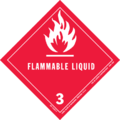
Flammable liquid
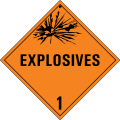
Explosives

This way up

Fragile material

Keep away from water


Comments
Post a Comment